
EV Tariffs Driven by Fabricated “Dumping” Claims Cost US Consumers $41.2B
US special interests deliberately spread a lie that harmed consumers
De facto bans on Chinese electric vehicles (EVs) cost Americans $41.2B on comparable EVs in 2023. This follows rapid price cuts by Chinese EV companies, which now undercut comparable American EVs by more than 25%.
Adjusting for market size and inflation from the 2023 paper, the present cost of these policies is estimated to be $43.12B for 2025.
Consumer welfare cost, 2023–2025
These policies gained widespread support after US politicians, automakers, and special-interest groups promoted the viral theory that Chinese automakers were “dumping” EVs in the US market – selling them below market value primarily due to CCP subsidies.
| Role | Actor | Claim | Source |
|---|---|---|---|
| President | Joe Biden | “China heavily subsidized all these products, pushing Chinese companies to produce far more than the rest of the world can absorb.” | 1 |
| President | Donald Trump | “Meanwhile, foreign automotive industries, propelled by unfair subsidies and aggressive industrial policies, have grown substantially.” | 2 |
| US Senator | Sherrod Brown | “American automakers and autoworkers need a level playing field – they cannot, and should not be expected to, compete with these heavily subsidized Chinese EVs.” | 3 |
| US Representatives | Mike Gallagher and Raja Krishnamoorthi | “electric vehicles (EV), propped up by massive subsidies and long-standing localization and other discriminatory policies employed by the PRC.” | 4 |
| Automaker | Ford Motor Company | “the need to protect our home market from a flood of subsidized vehicles built in China” | 5 |
| US auto industry group | Alliance for Automotive Innovation | “We need to make sure we’re all playing by the same rules, but Chinese automakers are flooding markets around the world with cut-rate vehicles.” | 6 |
| US auto industry group | Alliance for American Manufacturing | “China is unleashing a torrent of heavily subsidized cars upon the world, and America’s auto industry stands squarely in the path of devastation.” | 7 |
Proponents of the dumping theory claimed that reducing domestic competition for American manufacturers would enable them to develop and compete globally. With their support, American presidents enacted tariffs on foreign EVs reaching up to 127.5%.
US tariffs and de facto bans on Chinese EVs
- July 6, 2018TariffSection 301 List 1
25% additional tariff, 27.5% total
- September 27, 2024TariffSection 301 EV rate
100% additional tariff, 102.5% total
- April 3, 2025TariffSection 232 autos
25% additional tariff, 127.5% total
- Model Year 20273De facto banConnected-vehicle rule
Bans on China-linked software and manufacturers
Chinese EVs now dominate multiple global markets and continue to gain ground1.
In European markets, Chinese EVs have increased their market share despite heavy tariffs and regulations. Despite prior tariffs and subsidies in the US, subsequent administrations have had to enact de facto bans on Chinese EVs to prevent them from competing in the American market.
Chinese EV sales and market share across global markets
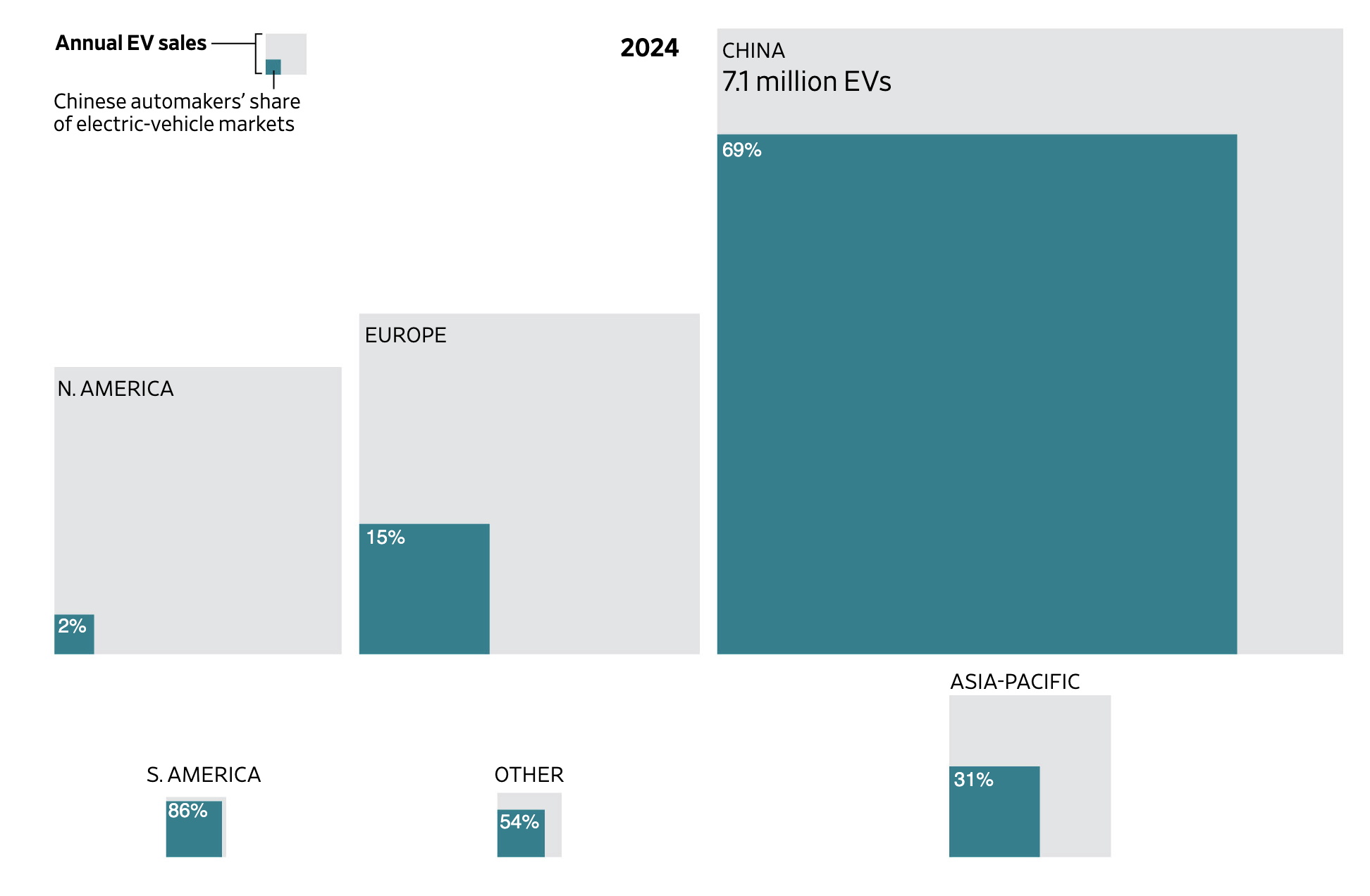
A key premise supporting these policies is almost entirely false. Claims of EV dumping were spread with no evidence that subsidies were the primary reason for Chinese competitiveness. Now, there is strong evidence against this theory.
EV Price Comparison
Less than 7% of the difference between Chinese and American EV prices is the result of government subsidies, loans, or lower profit margins. The vast majority of identifiable price differences are due to differences in supply chain and R&D structure.
Price Gap Breakdown
The price gap is wider for EVs than for comparable non-EV cars, in both absolute and percentage terms. This suggests that Chinese advances in EV-specific optimization are responsible for a significant portion of the price gap.
Non-EV price comparisons4
The de facto ban on Chinese EVs reduces the number of EV purchases by an estimated 1.61 million, according to the same paper2. The paper estimates that the gap in adoption forfeits 89.34 million metric tons of lifetime CO₂ reductions, the same as taking 266 million one-way flights or driving 227 billion miles in the average gas-powered car.
Despite the most powerful men in America repeating these false dumping claims, America’s political, judicial, and journalistic institutions failed to question them. Special interests and politicians succeeded into turning their fabricated myth into policy, directly tying false dumping claims to the announcement of new tariffs. Until recently, a politically convenient lie triumped over the uncomfortable truth.
Footnotes
1 Global-market sales source: The Wall Street Journal.
2 Table 2 reports modeled 2023 total EV sales of 1.380 million under the ban and 2.990 million after introducing the top ten Chinese EV models at the 2.5% baseline tariff. The implied difference is 1.610 million EVs. Column 3 separately reports 89.34 million tons of lifetime CO₂ reduction.
3 Model Year 2027 is a manufacturer's designation for a model developed for 2027. Production for these models typically begins a year earlier.
4 Conversion note. We use a fixed exchange rate of RMB 7.2 per USD 1 for data aggregated across model years 2024 and 2025. This fixed rate may differ slightly from the rate at any particular point during that period.
Models used in the comparison:
| Model | Source |
|---|---|
| Chevrolet Monza 1.5L Joy | Chevrolet China |
| Geely Emgrand 1.5L CVT Dragon | Autohome |
| Buick Regal 25T Enjoy | ZOL |
| Geely Preface 2.0TD Starlight | Geely |
| Cadillac CT5 28T Luxury | ZOL |
| Hongqi H6 2.0T Zhizhen | ZOL |
| Mercedes-Benz E 300 L Luxury | Autohome |
| Hongqi H9 3.0T Qichang Luxury Business | ZOL |