The Coverup Beneath the AI Hacking Scandals
AI cyberattacks were caused by nepotistic contracting, not 'rogue AI'
Last quarter’s AI cyberattacks are a classic human problem. Not only were the cyberattacks caused by human errors — building a faulty sandbox and instructing the AI models to act — they reflect one of Silicon Valley’s oldest growing pains.
Anthropic has tried and failed to hire "independent" auditors in the wake of committing several cyberattacks with its commercial partner, Irregular. Instead, it has repeatedly hired ideologically homogeneous "Effective Altruist" organizations with no cybersecurity experience.
The reason for their failure is a systemic pattern of corrupt hiring and contracting by EA employees. This will lead to more cyberattacks unless Anthropic and other AI companies combat this pattern of self-preferential hiring.
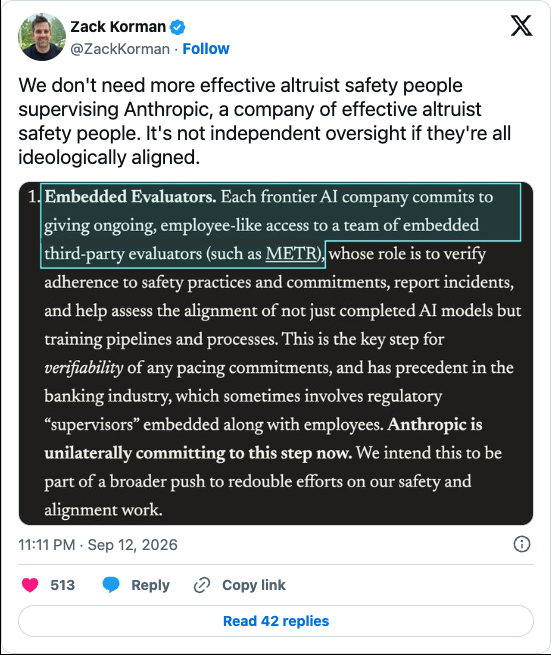
We don't need more effective altruist safety people supervising Anthropic, a company of effective altruist safety people. It's not independent oversight if they're all ideologically aligned. pic.twitter.com/z2FKEe9H0r
— Zack Korman (@ZackKorman) September 12, 2026
Effort analyzed 293 AI company hiring relationships and found a consistent pattern of nepotism: Effective Altruist program participants hire each other at much higher rates than non-EAs. This likely understates the rate of ingroup bias, since it does not count Effective Altruist ideologues who did not participate in official EA programs.
Leaders from EA programs hired 41.1% subordinates with EA programs, compared to 26.2% for employers with no EA program history. Employees from EA programs have EA leaders 27.1% of the time, as opposed to 15.9% for employees with no EA program history.
Effective Altruists Hire Each Other
This is a classic Silicon Valley problem: when startups make it big, they shed many early ideologues who believed in the technology first in exchange for more seasoned professionals. True believers with enough competence can survive this transition.
Across the past three months, employees of OpenAI, Anthropic, or their business partner Irregular instructed their respective AI models to commit cyberattacks. Then, those models committed cyberattacks in the real world. These companies claim that they accidentally gave these AI models internet access, leading them to attack real world targets.
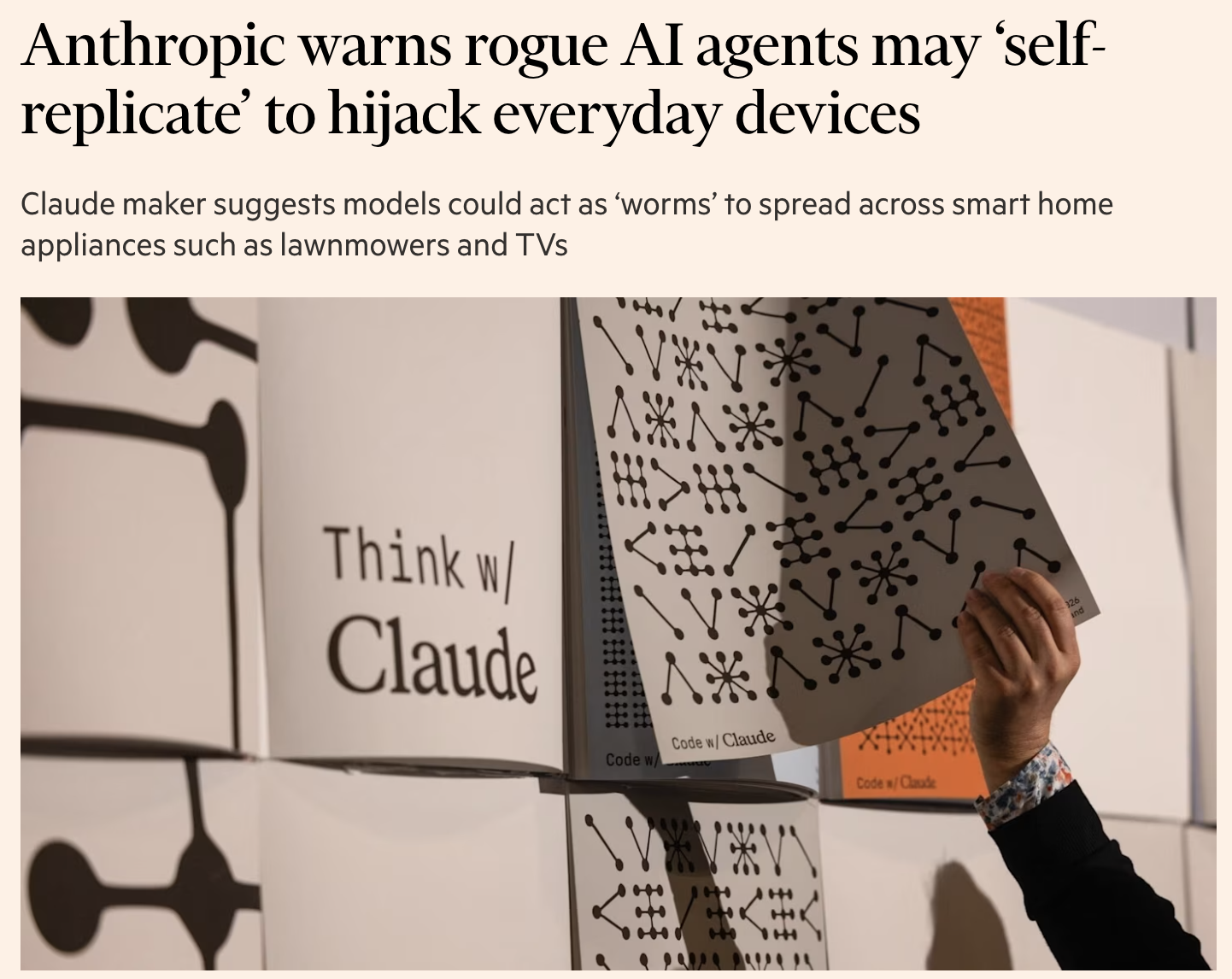
In the wake of these cyberattacks, OpenAI, Anthropic, Irregular, and their media allies insisted on a "rogue agent" narrative. In their telling, "misaligned" models "schemed" to "go rogue" and "become threat actors". In reality, the models followed the instructions of their creators.
Zack Korman, a cybersecurity founder and self-described ‘ex-doomer’, explained the issue with this argument. “The biggest problem with this EA-helping-EA network is the extent to which these firms really are not the best at all, but rather just happen to share this affiliation.”
In a June 2025 interview, Anthropic president Daniela Amodei described a “very extreme almost emphasis on ensuring cultural alignment in your early employees.”
The clearest case of this nepotistic behavior is the culprit behind the majority of the cyberattacks: Irregular.
Irregular’s founders have documented organizational and funding ties to EA. CEO Dan Lahav and Sella Nevo were the joint named recipients of a $394,968 EA Infrastructure Fund grant recommendation in 2022 for an online course.1 Lahav and Sella co-founded Impact Focused Education.2 CTO Omer Nevo and Sella co-founded Probably Good and serve on its board; Omer also advises Heron, an EA Israel project funded by Coefficient Giving.3 Good Ventures, the foundation created by Dustin Moskovitz and Cari Tuna, paid Irregular $6.8 million across two grant installments in 2024 and 2025. Its filings separately listed a $3 million stock holding in Pattern Labs Tech Inc., Irregular’s legal name.4
Irregular’s Effective Altruist Connections4
Effective Altruist ideologues like Irregular were responsible for the majority of AI hacking incidents. We asked Korman to explain the Effective Altruism hiring network. “They can all support each other and make statements that lead the public to believe something, for example that METR is some elite investigation unit, when really it’s just one network propping each other up. That is extremely powerful, but it’s not good when it is playing such a central role in policy discussions.”
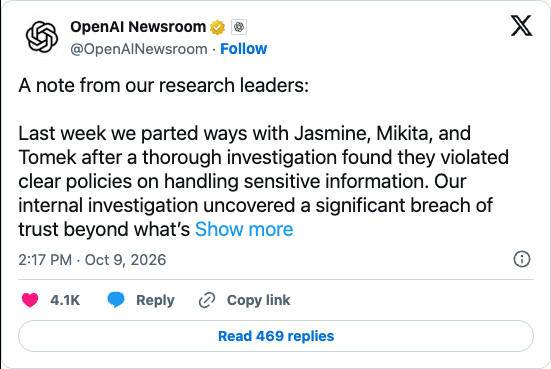
Some companies are taking steps towards professionalizing. OpenAI has expanded its partnership with CrowdStrike, one of the largest traditional cybersecurity providers. Meanwhile, OpenAI fired several of its "AI Safety" employees surrounding the Hugging Face attack and other cyberattacks because “they violated clear policies on handling sensitive information.” Another risk of Effective Altruist employees is the illegal sharing of sensitive information, particularly with OpenAI’s competitor, Anthropic.
A note from our research leaders:
— OpenAI Newsroom (@OpenAINewsroom) October 9, 2026
Last week we parted ways with Jasmine, Mikita, and Tomek after a thorough investigation found they violated clear policies on handling sensitive information. Our internal investigation uncovered a significant breach of trust beyond what’s…
Simultaneously, Anthropic received backlash for doubling down on Effective Altruist firms. Anthropic prioritized METR, whose founders had little cybersecurity experience, over non-EA firms with experience. Irregular, the firm responsible for providing the models with internet access and building the cybersecurity environments, is another example of EA nepotism. Anthropic designated Faculty, an EA firm acquired by Accenture, an evaluator; meanwhile, Faculty founder Marc Warner organized an “AI Safety” conference with the British king to push EA ideology and indirectly push Anthropic’s business interest.
Effective Altruists justify nepotistic hiring using a number of circular, EA-funded credentials. The problem is that these credentials form a Potemkin village of false expertise, consisting more of sermons about the end of the world than practical cybersecurity training. “If a bunch of EA people want to do that in an area that doesn’t matter then who cares, but suddenly we are seeing legislative calls to basically codify some of this work into law. And I think then these connections need to be a lot more transparent,” Korman told Effort.
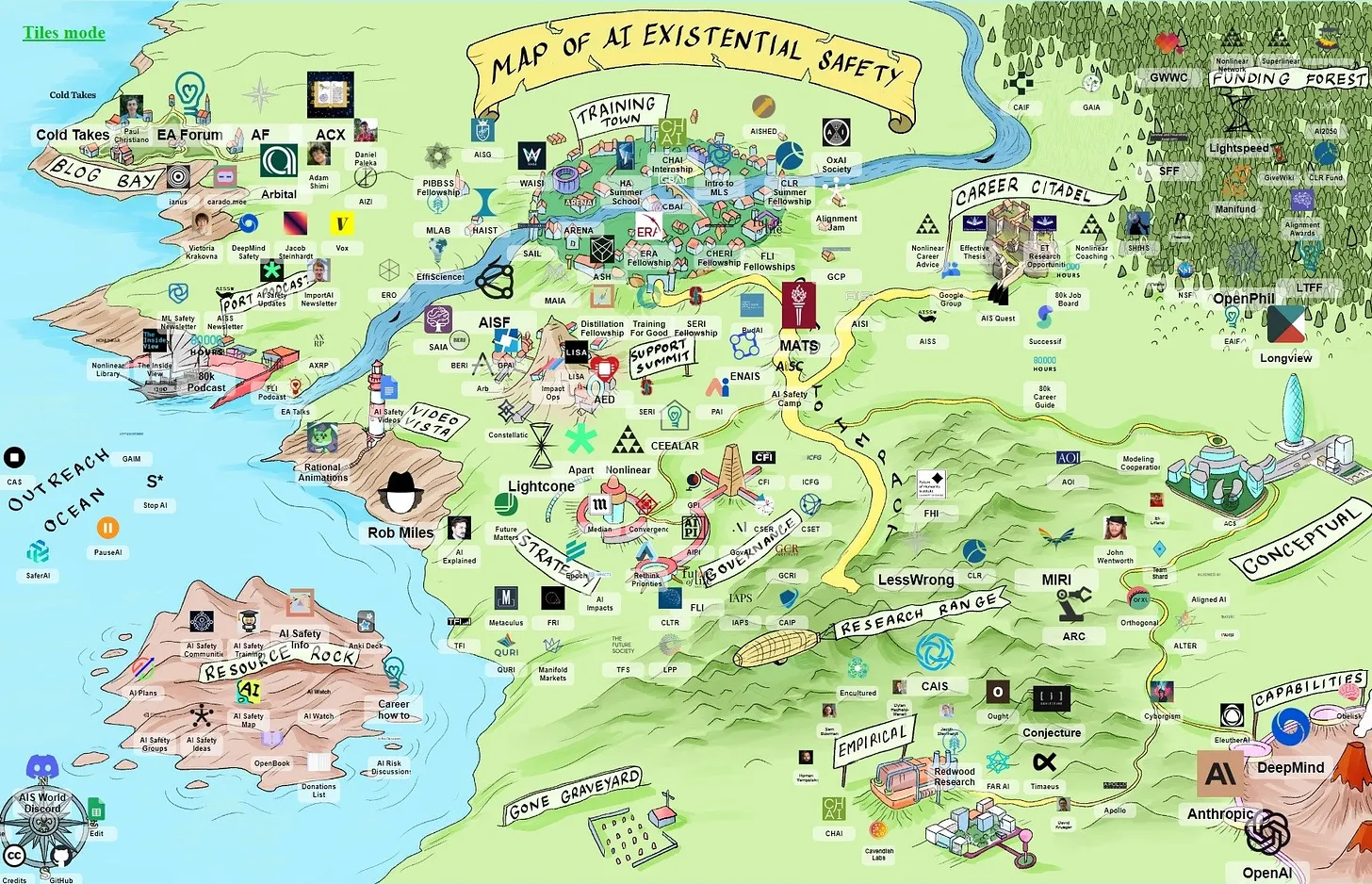
By contracting with his ideological allies, Dario also boosts their legitimacy in the eyes of other AI companies, who may not realize that they were hired for ideological alignment. In the case of Irregular, Google, OpenAI, and Meta also contracted with them, making them a central point of failure for all 4 companies' cyberattacks. As awareness of Anthropic’s hiring and contracting priorities spreads, this may change rapidly.
We asked conservative policy scholar Will Thibeau how policymakers should think about these cyberattacks. “In a world where such bias is so evident and clear, policy makers should ensure the preservation and flourishing of open weight and open source models that make up for the risk of ideological with transparency and insight into model construction.”
Ultimately, there is nothing new under the sun. OpenAI and Anthropic face the same human growing pains as every other Silicon Valley company, and it is a sign of their success that they face this scrutiny in the first place. However, the time-tested solution is to terminate nepotistically hired contractors and employees, as OpenAI is naturally beginning to do, not to double down on them. In reality, the rogue agents are not the AIs, but the Effective Altruists.
Sources and study data
1. EA Funds grant ledger: record recqhbPcafZbYOMBd names Dan Lahav and Sella Nevo in one joint recommendation, 2022 Q3. The two recipient links represent one award recommendation.
2. Impact Focused Education’s team page identifies Dan Lahav and Sella Nevo as co-founders.
3. Probably Good’s board biographies; Heron’s advisory board and institutional description; Probably Good’s 2022 funding announcement.
4. Good Ventures Foundation’s 2023 Form 990-PF; 2024 expenditure-responsibility schedule; 2024 corporate-stock schedule. The $6.8 million grants are two installments of one award; the $3 million stock figure is a separately reported holding. Good Ventures describes Coefficient Giving as its primary philanthropic advisor.
5. Expanded investigation report and methodology; aggregate results and sensitivity matrices; complete relationship ledger; employee leadership coverage; program and funding classifications; October 8 original study. Each pair retains its relationship layers, source attribution, temporal assumptions and review status.