Is AI Writing American Law?
We scanned every bill in the US Congress since 2023 to find out
AI models are writing our laws. An Effort investigation1 found the fraction of bills in the US Congress written by AI has tripled in the past three years.
AI in Congressional Bills2
Among congressional bills with preambles and findings sections, AI generated text rose from just under 2% to 6.4% likely AI written from Q1 2023 to in the last quarter, Q2 20262. The rate among bills with no preambles and findings is significantly lower. A large number of these bills are renewals, extensions and other copies of pre-AI legislation.
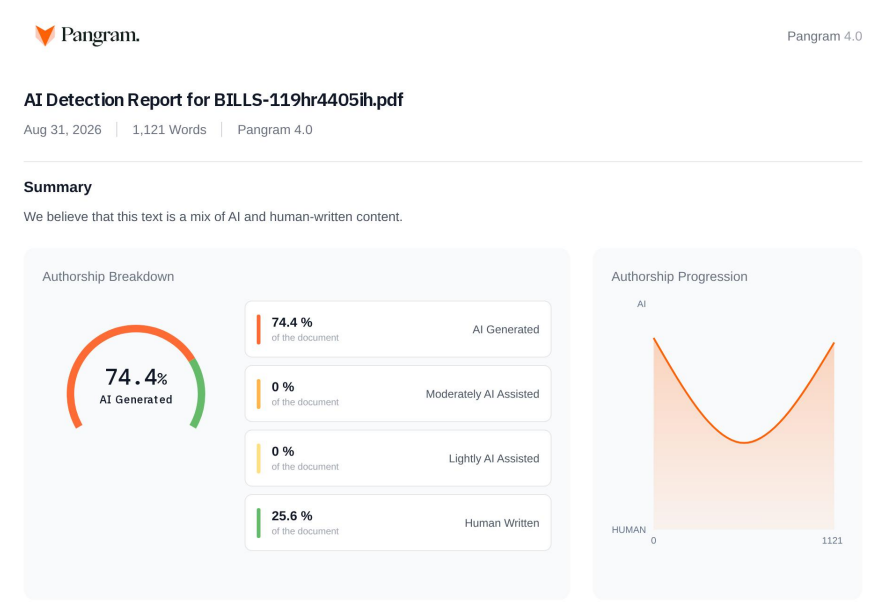
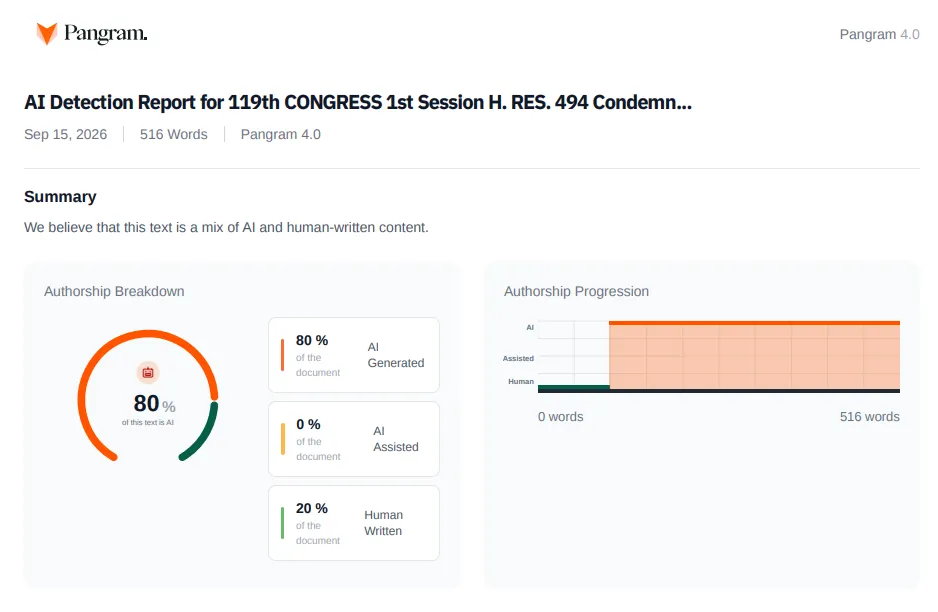
The Epstein Files Transparency Act is the only majority AI-written bill in our sample that became law. It is one of the most widely covered and politically divisive bills in the past year.
We confirmed that it was majority-written by AI using the state of the art AI detection model, Pangram 4. "Pangram's false positive rate is below 1 in 10,000: it is highly likely that text flagged as AI-generated by pangram was at least significantly if not fully generated by AI," Pangram's cofounder and CEO Max Spero told Effort.
The Epstein Files Transparency Act may violate the House AI use policy, according to a POPVOX summary. Neither the House or Senate AI policy is public, but the POPVOX foundation summarised the House policy.
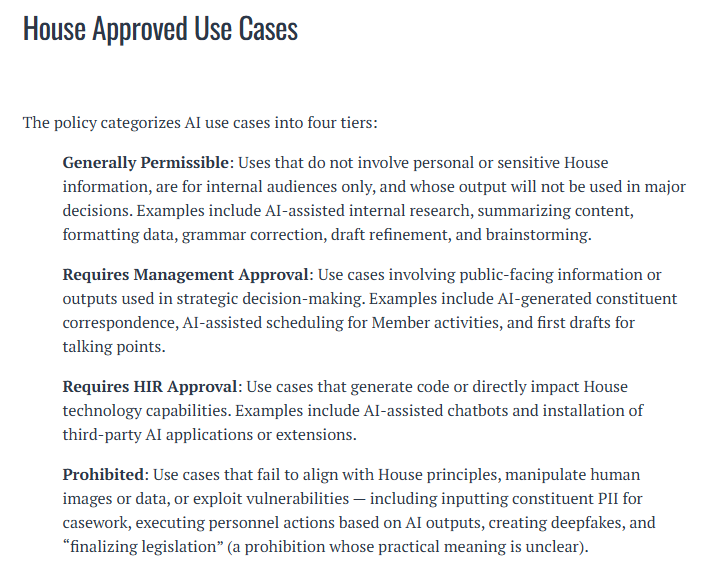
There is no public disclosure of AI use on any bill. The Epstein Transparency Act would be a clear case of 'finalizing legislation' with AI, which the policy prohibits. Staff are likely unaware of the House AI policy. As of publication, there have been no public consequences for undisclosed AI use in congress.
AI text is even more prevalent in Extensions of Remarks in the Congressional Record — AI wrote ~15% of them last quarter, more than twice the rate for bills3. We found no statistically significant difference between Democratic and Republican use of AI.
Across all policy4 areas we investigated, law enforcement and finance bills are the likeliest to be written by AI.5 Other factors have small, but statistically significant effects on likely AI usage.
Correlates of AI Likelihood5
Topic coefficients point to institutional mechanisms. Financial bills flagged as AI are sponsored by committees where a majority of members come from corporate backgrounds6. They tend to adopt AI faster than members from traditional government careers. At the other end, Labor bills are usually drafted with large unions, which are slower adopters, and are reviewed more carefully given their implications for the voter base.
Crime bills stood out because the mechanism was less obvious. One hypothesis is that many are responses to recent events requiring fast turnarounds. For example, in response to the Los Angeles ICE raids (6th June 2025), a bill was introduced in the House (10th June 2025) demanding condemnation of acts of violence against law enforcement officers, similarly in response to the assasination of Charlie Kirk (10th Sep 2025), a bill was introduced in the Senate (5th Nov 2025) demanding the death penalty for ideological motivated crime.
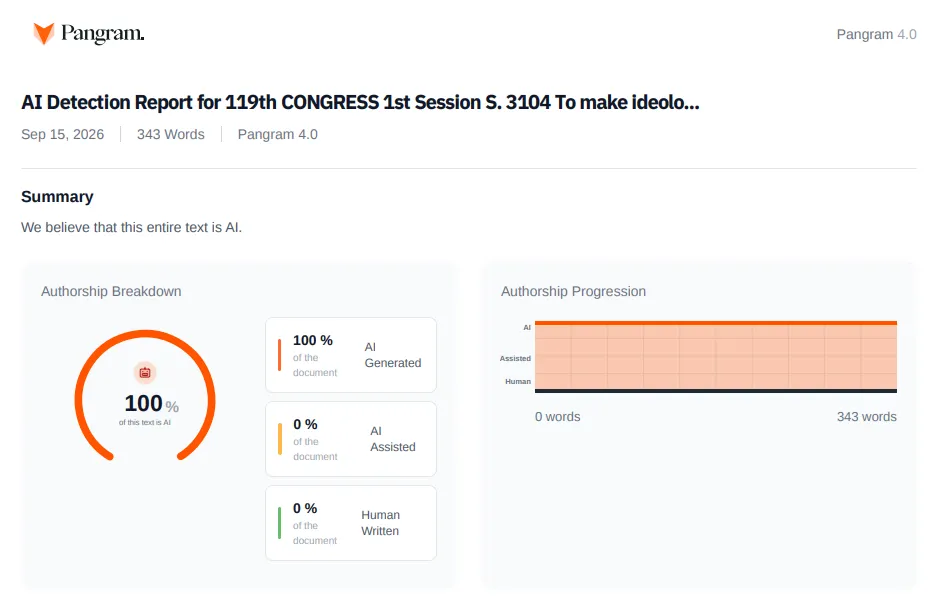
As AI becomes an ordinary part of an increasing number of Americans' lives, it is likely to become a more important part of the lawmaking process. The ability to detect AI use will shape norms around using and disclosing AI. "Pangram is a useful tool for enforcing AI policies, especially in high stakes situations such as legislation," Spero told Effort.
We use editlens_Llama-3.2-3B, an open-source version of Pangram, calibrated via Pangram 3.3.2 to improve accuracy.
Bills from the 118th and 119th Congress are analysed. (bills_full_analysis_data.csv) Data
Daily records from 118th and 119th Congress are analysed. (extensions_full_analysis_data.csv)
All bills 119th Congress Bills 2,994 100.0% 117 3.9% Reference category Senate, has cosponsors, older, non-pole topics 525 17.5% 6 1.1% House sponsor Senate 1,090 36.4% 23 2.1% House 1,904 63.6% 94 4.9% Solo sponsor Has cosponsors 2,509 83.8% 88 3.5% Solo sponsor 485 16.2% 29 6.0% 10y younger sponsor Older (>63) 1,464 48.9% 36 2.5% Younger (≤63) 1,530 51.1% 81 5.3% Longer bill (log words) Shorter (≤5.8 ln words) 1,499 50.1% 74 4.9% Longer (>5.8 ln words) 1,495 49.9% 43 2.9% Crime & Law Enforcement All other topics 2,810 93.9% 96 3.4% Crime topic 184 6.1% 21 11.4% Finance & Financial Sector All other topics 2,922 97.6% 109 3.7% Finance topic 72 2.4% 8 11.1% Labor & Employment All other topics 2,931 97.9% 117 4.0% Labor topic 63 2.1% 0 0.0% To understand the institutional mechanisms that drive AI use, we built a linear probability model built to predict whether a bill is flagged AI or not. Graph shows 90% CIs. (table at the end of the article) chart_data_for_recreation.xlsx · Data
Banking/Financial Services (combined) 77 49 (64%) 23 5 Intelligence 27 19 (70%) 5 3 Foreign Affairs 53 25 (47%) 25 3 Natural Resources 45 21 (47%) 19 5 Transportation & Infrastructure 67 32 (48%) 32 3 Science, Space & Technology 40 21 (52%) 15 4 Majority of the AI bills come from Banking and Financial Service committee
Crime & Law Enforcement 184 21 11.4% Finance & Financial Sector 72 8 11.1% Government Operations & Policy 183 15 8.2% Transportation & Public Works 80 6 7.5% Immigration 91 6 6.6% Education 123 6 4.9% Armed Forces & National Security 204 8 3.9% Health 357 13 3.6% Civil Rights & Liberties 110 4 3.6% Science, Technology & Communications 88 3 3.4% No topic flagged (reference) 578 13 2.2% International Affairs 600 12 2.0% Congress 90 1 1.1% Public Lands & Natural Resources 99 1 1.0% Environmental Protection 72 0 0.0% Labor & Employment 63 0 0.0% Total 2,994 117 3.9%